Yokohama Prison
A ManYokohama Prison is both a working correctional institution and the decisive meeting place in Akira Kido’s investigation of the family-register exchanges behind X’s identity. Kido’s visits there put him face to face with Omiura, the broker who may have connected X with the real Daisuké Taniguchi, and reveal that Omiura and Makoto Hara had been imprisoned in the same facility. That overlap turns the prison from a site of inquiry into the hinge of Kido’s most consequential deduction: that X was the real Makoto Hara, while another man had taken Hara’s family register and served time for his habitual shoplifting.
Setting and Institutional Context
Kido returns to Yokohama Prison after ten years away. His recent legal work has concerned civil cases, so the visit marks a passage back into a world of incarceration he has not encountered for a decade. He recalls Michel Foucault’s Discipline and Punish: The Birth of the Prison, which he read at university, while approaching a building that, apart from its enclosing wall, might be mistaken for a school. The contrast makes the prison’s institutional function feel less like an outwardly dramatic spectacle than a boundary surrounding an ordinary-looking place.
At reception, Kido fills out a visit request and checks in his bag. The prison houses B-class convicts, classified as having advanced criminal tendencies, including repeat offenders, as well as F-class convicts, described as foreigners requiring treatment different from that given to Japanese prisoners. The classification system matters to the investigation because Yokohama Prison is one of the few facilities in the Tokyo Correctional Precinct with accommodation blocks for B-class convicts. That detail later explains why Hara and Omiura could have been held there together; their shared location is not proof by itself, but it gives Kido’s theory a concrete institutional basis.
Kido’s First Visit to Omiura
The 2007 family-register exchange case draws Kido to Omiura. A man had fraudulently received a pension by pretending to be someone else, but the underlying arrangement was a mutually agreed register swap. The other participant wanted to persuade his fiancée that he had never been married and was ten years younger. Kido’s attention falls on the third party who brokered the exchange: Omiura, who received a suspended sentence as an accomplice and was later imprisoned for an investment scam involving a nonexistent business. The case suggested that he had arranged many other exchanges for a fee. Since the case dated to the same year Daisuké Taniguchi left his Osaka apartment and X appeared in Town S, Kido wonders whether Omiura had brought the two men into contact. He discovers that Omiura is serving his sentence at Yokohama Prison, only thirty minutes by train from Kido’s condominium, and arranges a visit.
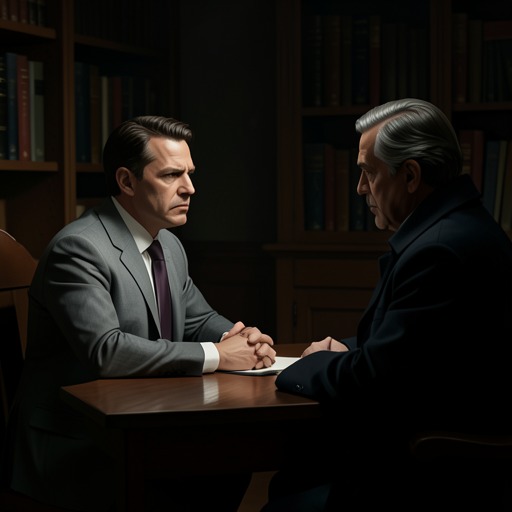
Omiura says he prefers to meet early, so Kido arrives at ten on a chilly, overcast morning. Escorted into the visiting room by a corrections officer, Omiura sits opposite him across a clear acrylic partition. He is a bald, heavyset man with an unusually large right eye, a smaller left eye, sparse eyebrows, and deep forehead lines. He greets Kido with delighted warmth and calls him handsome, then says his own inferiority complex about his appearance and his efforts to compensate for it helped land him in prison. The flattery seems insincere, but the admission beneath it strikes Kido as genuine. Omiura’s uneven gaze becomes, for Kido, an image of speech that encourages belief while concealing something at the same time.
The visit leaves Kido disturbed well beyond the interview. Omiura’s affability carries a latent threat, and his appearance of candor makes it difficult for Kido to decide what to trust. Afterward, Kido grows almost hateful toward him and tries to dismiss Omiura’s remarks about Kido not being a typical Zainichi Korean as a psychological game. Yet standing before a mirror, Kido feels as if he is again facing Omiura through the partition. The prison encounter has made the broker difficult to leave behind: Omiura persists in Kido’s thoughts as a reflection that disturbs Kido’s sense of himself.
Repeated Visits and the Identity Investigation
Kido learns that Omiura knew Daisuké Taniguchi and suspects that he may also know something about X. He would rather not return, but the investigation has become ominous: although he wants to establish, for Rié’s sake, that X was not a criminal, he now fears that something may have happened to the real Daisuké. He writes to Omiura again, hoping to finish the inquiry quickly. Ten days later he returns carrying a copy of Asahi Geino. Omiura accepts the magazine and offers a lengthy assessment of its nude feature, a mundane exchange that sits uneasily beside the criminal histories and identity questions Kido is pursuing.
The decisive connection emerges through Kido’s conversation with Kadosaki, the lawyer who represented Hara. Kadosaki explains that Hara had withdrawn from the All Japan Rookie King Championship Match, spent nearly a decade working as a day laborer, and repeatedly faced suspicion at work because rumors identified him as the child of a murderer. His shoplifting became habitual after his first conviction in 2006. Kadosaki had tried to have his childhood trauma and psychiatric history taken into account in court, but they did not affect the sentence; after his release, she introduced him to a psychiatrist and continued checking on him. When Kido asks where Hara served his sentence, Kadosaki answers: Yokohama Prison.
That answer transforms the prison’s significance. Because Yokohama Prison held B-class convicts, Hara’s imprisonment there is not inherently unusual. But it means that Hara and Omiura were almost certainly fellow inmates. Kido is astonished because the overlap supports the conjecture he had hesitated to believe: X was Kenkichi Kobayashi’s son and the real Makoto Hara, while the man imprisoned for compulsive shoplifting had exchanged family registers with him through Omiura. The prison does not itself confirm the exchange, but it supplies the missing association that makes the proposed chain of identities plausible. Kido tells Kadosaki that Hara’s descent from a man responsible for an atrocious crime could explain why he felt compelled to take on a different past.
The December Meeting and Narrative Significance
Kido later writes that he has researched the matter and now understands what Omiura was conveying through his postcards. Omiura replies immediately, without including an illustration, and says Kido may visit whenever he likes. The invitation seems peculiar precisely because Kido expects Omiura to ignore him. On December 29, Kido returns to Yokohama Prison. It is a snowless winter day with a cold wind; the law firm has closed for the year, the trains are thinning out, and the quiet of the Shogatsu holiday period gives Kido’s walk to the prison a melancholy weight. The setting’s recurrence changes with the season: the first visit is driven by professional suspicion, while the later one follows Kido’s attempt to interpret Omiura’s indirect clues.
When Omiura enters the visiting room, he points his chin at Kido, stretches one eye wide, and greets him as a Korean lawyer after their long interval. Kido’s facial tension eases. The exchange does not erase the distrust established at their first meeting, but it shows that their encounters have become a channel through which withheld information can be approached. Across the visits, Yokohama Prison gathers several strands of the novel’s identity plot in one confined space: the mechanics of register exchange, Omiura’s role as broker, Hara’s imprisonment, and Kido’s own uneasy confrontation with identity and belonging. Its clear partition is a literal barrier between visitor and inmate, but also a fitting image for an investigation in which people’s visible names and lives never fully disclose the histories on the other side.